A more defined nasal tip depends on support as much as shape. Bulbous tip rhinoplasty correction may reshape or reposition the tip cartilages, use sutures to refine their contour, or add cartilage support when needed. If the tip also droops, the approach can address its position and the angle between the nose and upper lip.
It’s understandable to focus on a rounded appearance, but the underlying cartilage, skin thickness, and tip support all affect how much definition surgery can achieve. A careful plan aims to refine the contour while preserving a stable, natural-looking nasal structure.
This article explains common causes of a bulbous tip and what happens during surgery, including how surgeons choose among reshaping, sutures, and grafts. It also covers drooping tips, including those that lower when you smile, and what to know about recovery and the scope of tip-focused surgery.
Key Takeaways
- A rounded nasal tip can reflect the shape or position of its cartilage, thicker skin, or soft tissue beneath the skin. Understanding the cause helps clarify which refinements may be appropriate.
- Surgeons can use sutures, careful cartilage reshaping, or grafts to refine the tip while maintaining support.
- Thick skin can soften the visibility of underlying cartilage definition, so the surgical plan must account for both the nasal framework and its covering.
- A tip-focused approach may not address concerns involving the bridge or broader nasal structure, making the relationship between these features important to assess.
- A drooping tip, including one that moves downward when you smile, can be addressed with techniques that support or reposition the tip and adjust its angle.
What is a bulbous tip and what causes it?
A bulbous nasal tip looks rounded or broad, often because of cartilage shape, skin thickness, or both. Bulbous tip rhinoplasty correction targets the structures that create the contour while preserving support.
Nasal Tip Anatomy and Causes
The lower lateral cartilages are paired structures that shape and support the nasal tip. Their width, curve, orientation, or insertion points can create a rounded contour, especially when they flare outward. Weak cartilage may spread flat rather than project forward, changing the tip’s outline. These differences matter because refinement depends on the anatomy beneath the skin, not just the visible width.
Genetics is the main cause of a bulbous nose, while untreated rosacea is another possible cause. Thick nasal skin can soften the definition of the cartilage beneath it, and excess soft tissue or fat under the skin may add fullness. These factors can occur together, so a broad tip doesn’t always reflect cartilage alone. Identifying each structure’s contribution helps explain why refinement must be tailored to the individual nose.
Recognizing a Bulbous Nasal Tip
A bulbous nasal tip generally appears rounded, wide, or less defined than the bridge above it. From the front, the tip may look disproportionate if it is wider than the bridge. A balanced nasal tip is often described as equal in width to the bridge when viewed from the front. This comparison is a guide, not a requirement that every nose have identical proportions.
Assess the tip from the front and side rather than judging it from one angle. For example, outward-flaring lower lateral cartilages may create visible width from the front, while thicker skin can make the tip look less defined in profile. The bridge, tip projection, and surrounding facial features also affect overall appearance. Considering these relationships helps distinguish a broad tip from proportions shaped by other features.
The goal is usually a defined, balanced, supported tip, not a sharply pinched one. A soft triangular contour is one possible result of cartilage reshaping. The appropriate outline depends on the cartilage’s strength and position, the skin covering it, and how the tip relates to the bridge. Removing too much supporting tissue can compromise the structure, so definition must be balanced with stability.
After rhinoplasty, the nose may take up to a year to fully settle into its new shape. Results are generally permanent, although aging may change the nose over time. Swelling can make the early appearance differ from the settled contour, so the final shape is assessed over time rather than immediately after surgery.
What Happens During Bulbous Tip Rhinoplasty?
Surgical refinement changes the cartilage framework beneath the skin. Reshaping, sutures, or grafts can improve definition while maintaining support.
Cartilage Reshaping and Suturing
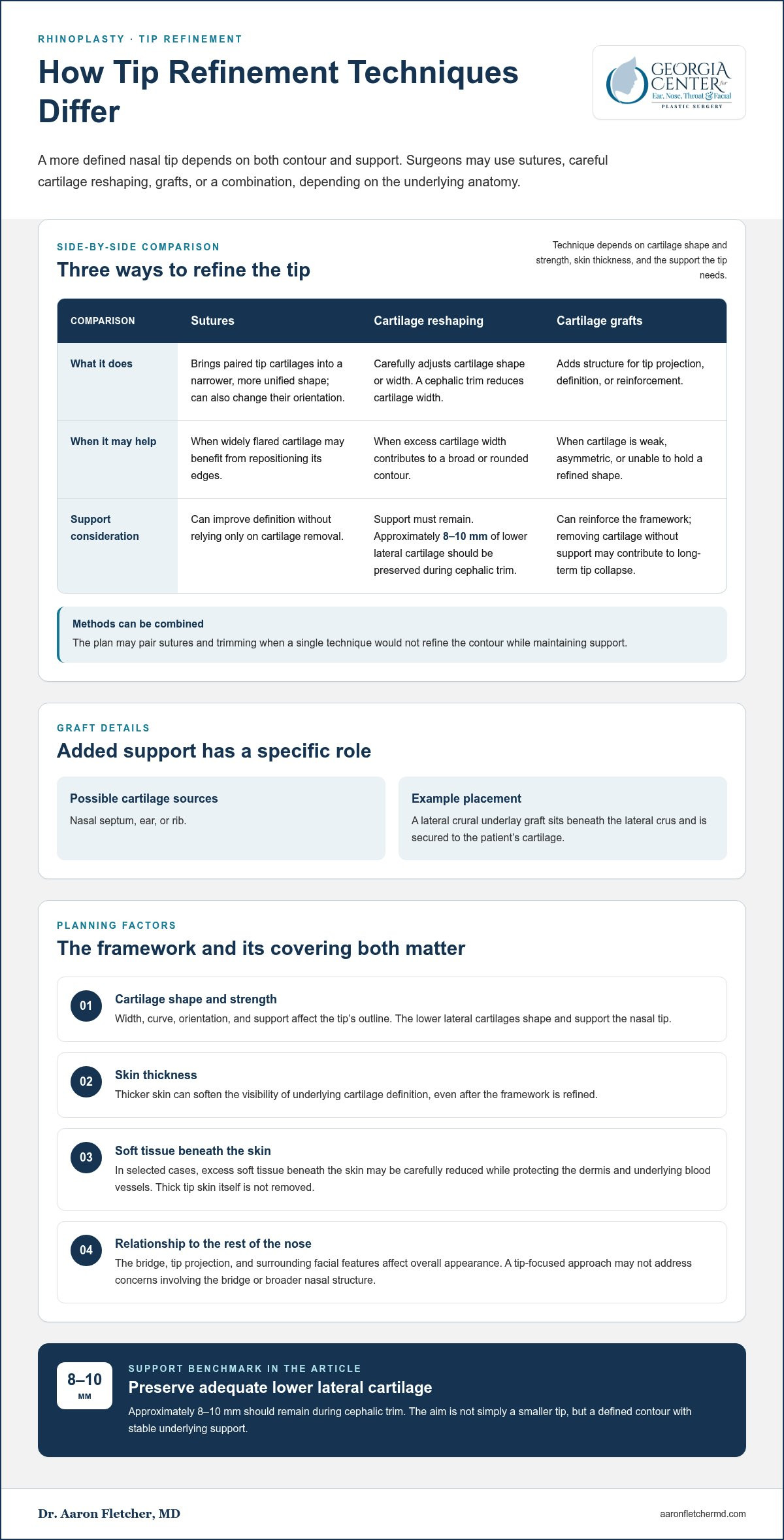
Lower lateral cartilage sutures bring the paired tip cartilages into a narrower, more unified shape. They can also alter their orientation, improving definition without relying only on removal. A cephalic trim reduces cartilage width, but adequate support must remain: approximately 8-10 mm of lower lateral cartilage should be preserved. Removing too much can weaken the tip and affect its long-term stability.
The technique depends on the cartilage’s shape and strength. Widely flared cartilage, for example, may benefit from sutures that reposition its edges, while excess width may call for careful trimming. Surgeons may combine these methods when one technique alone would not refine the contour and maintain support.
Grafts for Tip Support and Definition
Cartilage grafts add structure where the tip needs projection, definition, or reinforcement. Graft material may come from the nasal septum, ear, or rib. A graft placed on the lower lateral cartilage can help shape the tip. A lateral crural underlay graft sits beneath the lateral crus and is secured to the patient’s cartilage.
Grafts can help when tip cartilage is weak, asymmetric, or unable to hold a refined shape. Removing cartilage without support may fail to correct recurvature and can contribute to long-term tip collapse. The goal is not simply a smaller tip, but a defined contour with stable underlying support.
Skin and Cartilage Contributions
Skin thickness affects how clearly the reshaped cartilage shows through. Thick nasal skin can obscure definition, even when the underlying framework has been refined. Surgeons don’t remove thick tip skin. In selected cases, they may carefully reduce excess soft tissue beneath it while protecting the dermis and underlying blood vessels.
Assessment considers both the cartilage framework and its covering. A thinner covering can reveal structural changes more readily, while thick skin may soften the visible result. That’s why reshaping alone doesn’t produce the same appearance for every patient. Skin quality and cartilage support both inform the surgical plan.
Insurance coverage isn’t determined by tip shape alone. The relevant distinction is whether surgery addresses functional concerns as well as appearance. Plan terms and the documented purpose of surgery guide coverage decisions.
In the United States, the price depends on the case and is given after a quote request. Factors include the surgical techniques required, whether grafts are needed, and the scope of the procedure.
A discussion of rhinoplasty planning can help clarify how cartilage support and skin thickness relate to your goals.
Choosing an experienced rhinoplasty surgeon
Tip refinement requires attention to cartilage support, skin thickness, and how the nose relates to your facial features. The planned scope matters too: a tip-only procedure may not address concerns elsewhere on the nose.
Evaluating Surgeon Experience and Expertise
Experience with facial cosmetic surgery matters because tip anatomy and skin characteristics affect how refinement is planned. During an assessment, the surgeon examines the nasal-tip structure and skin thickness, then considers how the tip relates to the bridge and your facial features.
Use that discussion to understand which structures contribute to your concern and how the proposed approach addresses them. For example, ask how the plan will preserve tip support if cartilage is reshaped. A clear explanation connects the procedure’s scope to your goals rather than treating the tip as separate from the rest of the nose.
Assessing Suitability for Tip-Only Surgery
Tip-only surgery focuses on the lower third of the nose, so it may not suit concerns involving broader structural changes. A markedly crooked bridge or significant hump may require an approach beyond tip refinement. Considering the bridge alongside the tip helps prevent a limited procedure from leaving the main concern unaddressed.
Previous nasal surgery can alter normal anatomy and make tip-focused surgery more technically demanding. Tip-only approaches are also less common because focusing only on the tip may, in some circumstances, contribute to weakness over time. These factors make the relationship between the nasal framework and the requested change central to planning.
Bulbous tip rhinoplasty can carry structural risks if cartilage support is not preserved. Removing cartilage without graft support may fail to correct recurvature and can lead to long-term tip collapse. Weak or asymmetric cartilage can also make refinement more challenging.
Recovery planning includes temporary activity limits. Patients are advised to wait two weeks after nose surgery before strenuous activity, avoid non-contact sports for three weeks, and avoid contact and ball sports for at least six weeks after surgery. Light physical activity generally resumes after three to four weeks, while planning about 10 days away from work or regular activities can help accommodate early recovery.
Follow the specific recovery instructions provided for your procedure, since activity restrictions differ by intensity and impact. Returning to light exercise is different from resuming a ball sport, which can expose the healing nose to impact. A structured plan helps distinguish these stages and protect the surgical result during healing.
Rhinoplasty techniques for tip refinement
Tip refinement techniques are selected according to the nasal structure and the change a person wants. A bulbous appearance, limited projection, or a downward-pointing tip may call for different adjustments. The aim is to refine the contour while keeping the tip supported and in proportion with the bridge.
A tip-focused procedure addresses the lower third of the nose, including the tip and sometimes the nostrils. The scope of a tip-focused procedure depends on the individual’s nasal structure and surgical plan. This distinction clarifies the procedure’s scope: someone concerned about tip width may consider a limited approach, while a crooked bridge or significant hump involves a broader structural concern.
Surgeons can use sutures to narrow and reshape the lower lateral cartilages that form the tip. Cephalic trimming reduces the width of these cartilages, while a cephalic turn-in flap is another refinement technique. Combining sutures with careful trimming can address both cartilage orientation and excess width. The choice depends on the cartilage’s shape and the support needed to maintain the tip’s structure.
Grafts can add definition or support when the existing framework needs reinforcement. Examples include a Peck onlay graft or a shield graft, each used as a structural element in tip refinement. Placement depends on the desired shape and underlying anatomy. These options show why a precise plan may combine reshaping with added support rather than relying on removal alone.
An open approach gives the surgeon a view of the lower lateral cartilages in their natural position, without distortion. The incision is mostly inside the nostrils, with a small visible portion on the columella. This direct view can be useful when the cartilages need detailed assessment or repositioning. The approach is selected to suit the structural work, not because one technique is universally preferable.
People seek tip refinement for concerns such as a rounded contour, outward-flaring cartilage, or a tip that looks out of proportion to the bridge. For example, someone may want a more defined outline without changing nasal length. Another person may want the tip and nostrils considered together. These distinctions shape the surgical plan and clarify what a tip-focused procedure can address.
Rhinoplasty techniques are selected as a coordinated plan: assess the tip’s framework, identify the requested change, then match reshaping, sutures, or grafts to that structure. The bridge and overall nasal proportions remain important context, even when the tip is the main concern.
Correcting a drooping tip
A drooping nasal tip points downward at rest or moves lower when you smile. Tip procedures can address its position as part of bulbous tip rhinoplasty correction, helping balance the tip with the bridge and upper lip.
First distinguish a tip that sits low consistently from one that descends mainly when smiling. Smile-related movement can make the tip appear shorter or change the nose-to-lip relationship in photographs. Describing when the change occurs gives the surgeon a clearer picture of your concern. The distinction matters because a plan for resting position must also account for movement during expression.
Tip support and position are connected. Sutures can reshape or reposition the tip cartilages, while cartilage grafts can provide added support. For example, a graft may reinforce the framework when the goal is to improve projection or resist downward positioning. The choice depends on the existing cartilage and desired balance, not just the tip’s appearance.
The angle between the nose and upper lip is another part of the assessment. Adjusting this angle can contribute to a more balanced profile, but the aim is not an exaggerated upturned appearance. The bridge, tip projection, and facial proportions all influence how the change looks from the side. A precise plan considers these relationships together.
Bulbousness and drooping can occur together, so procedures may combine contour refinement with structural support. Narrowing the tip without addressing its downward position could leave the central concern unchanged. Lifting the tip without considering its width may not create the definition a person seeks. Planned changes should address both shape and position while preserving support.
Previous nasal surgery adds another consideration. It can alter normal anatomy, making revision or tip-focused procedures more technically demanding. The existing structure, prior changes, and current direction of the tip all guide the approach. A useful discussion focuses on the specific concern, such as a tip that drops when smiling, rather than only asking for a lifted appearance.
Advanced refinement is measured by how the tip relates to the rest of the nose, not by elevation alone. A balanced result considers the bridge, upper lip, cartilage support, and movement during smiling. If your tip droops, describe whether it lowers at rest, with expression, or in both situations. Those details help focus the discussion on your goals.
Discuss your nasal-tip goals to explore how position, support, and smile-related movement can inform a rhinoplasty plan.
Dr. Aaron Fletcher, MD: Facelift
Dr. Aaron Fletcher, MD offers facelifts for people whose concerns involve facial aging rather than nasal-tip shape. A facelift addresses different goals from rhinoplasty, the relevant procedure for changes to nasal-tip contour or position.
If your concerns extend beyond your nose, distinguishing your goals can help identify the relevant procedure. Someone seeking tip definition may discuss rhinoplasty, while someone focused on facial aging may explore a facelift. Dr. Aaron Fletcher, MD also offers blepharoplasty and sinus surgery, each for different concerns.
For guidance on whether rhinoplasty or another facial procedure fits your goals, contact Dr. Aaron Fletcher, MD.
Turn Your Goals Into a Clear Next Step
The most useful next step is to define what you want to change and what you want to preserve. For bulbous tip rhinoplasty correction, that might mean a more defined contour, a different tip position, or a result balanced with your features. Naming your priorities can make the conversation more focused and personal.
Dr. Aaron Fletcher, MD offers rhinoplasty for nasal concerns, as well as facelifts and blepharoplasty for distinct facial goals. These procedures address different needs, so begin with the change that matters most to you. You can also note what you want to understand about the approach, recovery, and how your goals inform planning.
When you’re ready to discuss your priorities, contact Dr. Aaron Fletcher, MD. A thoughtful conversation can help you consider your options with greater clarity and take the next step at your own pace.
Frequently Asked Questions
Key Takeaways: What Is the Best Treatment for a Bulbous Nose?
The best treatment depends on what creates the fullness and what changes you want. Cartilage shape, skin thickness, tip support, and the relationship between the tip and bridge all inform the approach. Sutures may refine cartilage position, while grafts can add support. If your concern includes a drooping tip, discuss that separately from width so the plan addresses both shape and position.
What Is a Bulbous Nasal Tip?
A bulbous nasal tip is a rounded or broad-looking tip with less visible definition. It may appear wider than the bridge from the front, although facial proportions affect the overall appearance of the nose. A rounded contour can reflect the underlying cartilage, the skin covering it, or both. The term describes appearance, not a single anatomical cause or fixed treatment.
Is Tip-Only Surgery Simpler Than a Full Rhinoplasty?
Tip-only surgery may be more limited when the bridge is balanced and internal nasal support is strong, but it isn’t automatically simpler. The tip’s cartilage still needs careful assessment and support. A markedly crooked bridge or significant hump may call for broader structural work. Previous nasal surgery can also change the anatomy, making a tip-focused procedure more technically demanding than its limited scope suggests.
What Is a Tip Plasty?
A tip plasty focuses on the lower third of the nose, particularly the nasal tip and sometimes the nostrils. It doesn’t aim to change the bridge or overall nasal length. Someone concerned about tip width, for example, may discuss whether this focused procedure addresses that goal. The bridge and supporting structure still matter when deciding whether a tip-only approach fits.
What Causes a Bulbous Nasal Tip?
A bulbous appearance can result from wide or outward-flaring lower lateral cartilages, weak cartilage, thick skin, or excess soft tissue beneath the skin. Genetics is the main cause of bulbous noses, while untreated rosacea is another possible cause. These factors can overlap. Broad cartilage beneath thick skin, for example, may produce a rounded appearance with less visible definition than cartilage shape alone would suggest.
How Is Bulbous Tip Rhinoplasty Performed?
Bulbous tip rhinoplasty reshapes the nasal framework to refine the tip while maintaining support. Depending on the cartilage, the surgeon may use sutures, reshape or reposition cartilage, or add grafts. An open approach provides a direct view of the lower lateral cartilages in their natural position. The method follows the anatomy and goals being addressed, rather than a single standard technique.
What Techniques Are Used to Refine a Bulbous Nasal Tip?
Common techniques include sutures to narrow or reposition the lower lateral cartilages, cephalic trimming to reduce cartilage width, and grafts to add definition or support. Surgeons may combine sutures with trimming when both orientation and width need attention. Grafts can come from the nasal septum, ear, or rib. Preserving a supportive framework is essential when refining the tip’s contour.
Who Is a Good Candidate for Bulbous Tip Rhinoplasty?
A potential candidate has a specific concern about nasal-tip shape or position, and facial growth has finished. Assessment considers tip structure, skin thickness, and how the tip relates to the bridge and facial features. Someone with a balanced bridge, for example, may have a different procedural scope from someone concerned about a crooked bridge or significant hump. These factors help determine whether a tip-focused approach matches the concern.